Free · Thailand
Travel eSIM, SIM or Long-Stay Plan?
An eSIM advertisement promises data for your trip. A shop offers a physical SIM with a Thai number. A monthly plan appears cheaper when you divide its price by the days you expect to stay. These offers may solve different problems. The useful comparison is not simply digital versus plastic: it is whether your phone can use the service, whether the package includes what you need, and whether its start and end conditions fit your stay.
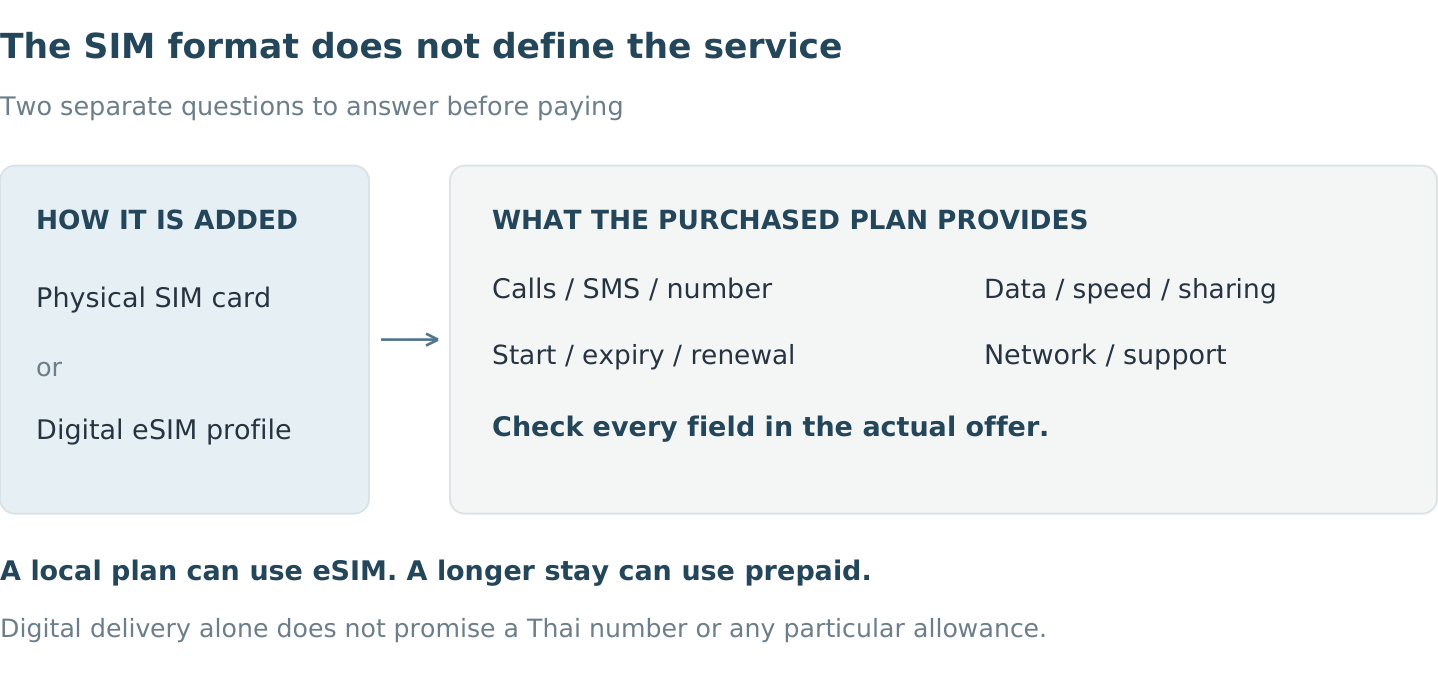
An eSIM is a way to provision a mobile line digitally rather than inserting a removable card. It does not, by itself, tell you the network, call allowance, subscription period or price. A local plan can use an eSIM; a longer-term arrangement can be prepaid. Treat the advertised label as the beginning of your questions, not their answer.
This guide is for visitors and temporary residents comparing connectivity in Thailand. It offers a purchasing checklist, not a carrier ranking, coverage guarantee or list of current deals. Examples are invented. Manufacturer and operator guidance was checked on 1 November 2026; verify the exact offer again before paying.
1. Write down the jobs your connection must do
Start with a short needs list: travel dates, places you will stay, phone model, and the services you cannot comfortably lose. Separate essential tasks from conveniences. A map and messages on arrival are a different requirement from a daily laptop hotspot or ordinary calls to local businesses.
Ask whether you need a Thai telephone number, incoming calls, outgoing calls, SMS, or only internet access. Messaging through an app is not the same service as receiving an SMS sent to a telephone number. Do not assume that an app login or verification system will accept a number merely because it belongs to a Thai mobile plan; confirm that with the service concerned.
Decide what must happen to your home number. You may need it for existing contacts or account verification, but keeping that line active can have charging implications. Before departure, ask your home provider about roaming, calls, messages and voicemail under your actual plan. Having a second line does not automatically protect the first one from charges.
Finally, decide who can help if setup fails. Someone arriving late with no other connection may value confirmed support arrangements more than a small headline-price difference. Save your accommodation address and a way to reach it offline rather than making the first journey depend entirely on successful activation.
2. Check the phone before comparing packages
Use the exact device model and the region in which it was sold, not just the product family name. Check the manufacturer's specifications and the intended provider's compatibility instructions. Samsung explicitly notes that eSIM availability depends on model, region and carrier; a familiar-looking settings menu is not a complete compatibility test.
For iPhone, Apple says the device must not be locked to another carrier to use a different carrier abroad. Its support instructions explain how to check Carrier Lock in the device information. If a restriction appears, contact the locking provider before purchasing. Do not pay an unrelated seller who promises to bypass a lock.
Also confirm whether the phone supports the combination you intend to use: a physical card and an eSIM, or two active eSIMs. Storage capacity for downloaded profiles is not the same question as how many lines can operate at once. For other devices, follow their own manufacturer's guidance rather than copying iPhone instructions.
Installation may require an existing internet connection. Arrange that in advance and keep the provider's instructions accessible on another screen or offline where practical. If replacing a physical card, store the original safely. Do not discard packaging or delete an eSIM profile as a first troubleshooting step; ask the provider about recovery and replacement.
3. Compare the service rather than the format
Use this table to classify offers. The rows are not mutually exclusive: a Thai prepaid plan might be delivered as an eSIM, and a travel package might include a local number.
| Offer to investigate | Useful question | Do not assume |
|---|---|---|
| Travel data eSIM | Does this specific package include only data, or also a usable number, calls and SMS? | That installing it supplies a Thai telephone number |
| Thai prepaid SIM or eSIM | What does the initial package include, and what happens when it expires? | That adding credit renews the same package |
| Longer-stay prepaid arrangement | Can I continue with suitable add-ons and keep the number valid? | That package validity and number validity are identical |
| Postpaid arrangement | Am I eligible, and what are the billing, commitment and cancellation terms? | That a monthly price means a one-month commitment |
| Existing home-plan roaming | Is Thailand covered, with what limits and extra charges? | That a travel pass covers every service or network |
Apple's travel guidance distinguishes local-carrier plans from worldwide-provider data plans and notes that data-only offers exist. Check the individual product description rather than treating every travel eSIM alike.
For a longer stay, request the actual eligibility and document requirements from the operator. Ask about deposits, payment methods, billing dates, minimum terms and the process for ending service. A visitor's length of stay alone does not establish eligibility. Do not sign a contract you cannot understand; ask for a clear explanation and retain the version you accept.
4. Separate registration from installation and package time
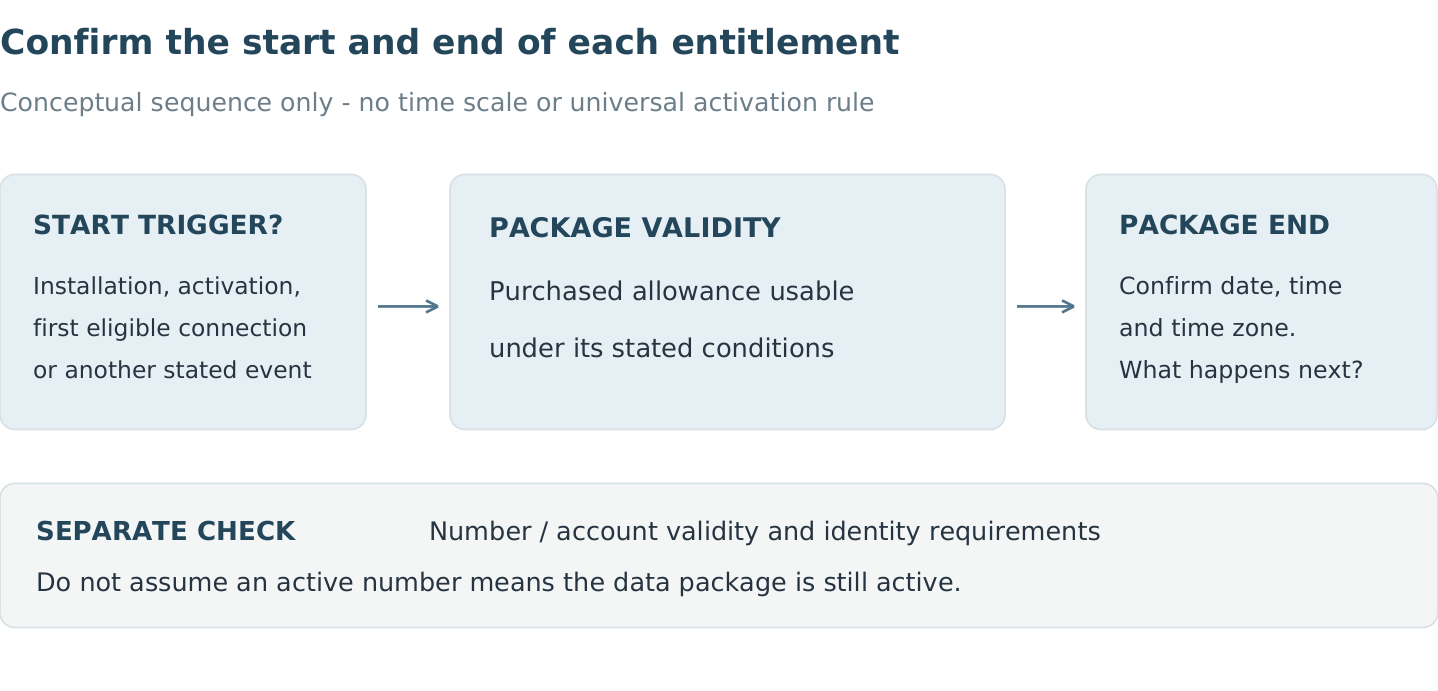
Registration establishes the subscriber's identity. Installation puts the card or digital profile on the device. Activation and package validity determine when the service and its allowances can be used. Providers may combine some steps, but you should not assume that completing one settles all the others.
For Thai operator service, use the provider's official registration channel. dtac's tourist registration page tells customers to bring their passport, SIM and packaging for its assisted registration route. Confirm the current process for your chosen physical SIM or eSIM; an online route may have different steps. Never send identity documents to a stranger merely because they offer to activate a line for you.
AIS's tourist page, checked for this guide, states that foreign tourists continuing its tourist SIM beyond 60 days from activation must reconfirm identity. It also describes a separate requirement to activate a registered number within 60 days or verify identity again. These are operator-published instructions, not a promise that every package lasts 60 days. Ask your own provider what applies to your line and dates.
Before buying, get answers to four distinct timing questions:
- How long may I wait after purchase before installing or activating?
- Which event starts the purchased allowance: installation, activation, first eligible connection, or another stated event?
- At what date, time and time zone does that allowance end?
- What separately determines whether the number or account remains usable?
Do not infer the answers from a screenshot saying “15 days.” Save the exact terms and confirmation message. If two provider pages disagree, ask support to identify the conditions attached to the product in your order.
5. Read data quantity, speed and sharing separately
A data allowance in gigabytes describes quantity. A speed figure in megabits per second describes a rate. A validity period describes time. None can substitute for the others. Ask what happens when the high-speed allowance is exhausted: slower access, stopped data, a charge from credit, or another outcome specified by that package.
For example, dtac's tourist information page presents both unlimited offers and offers with a stated maximum-speed allowance. The word “unlimited” on its own is therefore not enough to compare products. Read the complete allowance and applicable conditions; this guide does not carry forward any advertised price or quota as a guaranteed current deal.
If you plan to connect a laptop, ask specifically about hotspot or tethering permission, any separate allowance and any restriction on sustained use. Check the activities you actually need rather than translating “fast” into a promise about video meetings. A device's ability to create a hotspot does not settle a package's commercial conditions.
Use your existing phone's data-usage records as a starting point for an estimate, then account for activities that will change. Large uploads, app updates and streaming may not resemble your normal routine. You can download maps or documents in advance and review background-data settings, but do not rely on a precise estimate if uninterrupted access is essential.
Keep a simple comparison note with separate fields for quantity, speed, time and sharing. If a seller cannot explain one of them, leave it marked “not confirmed.” An empty field is more useful than a confident guess.
6. Check coverage at the places that matter
Ask which underlying network the offer uses in Thailand and whether the plan has any restrictions relevant to your route. For a reseller, distinguish the company taking your payment from the network carrying the connection. Confirm who handles technical problems and refunds.
Look at the network's coverage information for your actual accommodation and planned travel areas, then treat it as a planning aid rather than proof of performance in a particular room. A claim about Thailand as a whole does not answer a question about a basement, an upper floor, a moving vehicle or a remote stop.
Where practical, test the service before relying on it for a time-sensitive task. At accommodation, check the place you will actually use the phone. If you need a dependable backup, establish how you will access it and what it costs. Two differently branded offers may use the same network, so their labels alone do not demonstrate independent coverage.
For remote travel, retain offline directions and contact details. This article does not verify emergency calling, emergency-number routing or coverage for any device or location. Do not substitute a mobile-plan purchase for a trip-specific safety plan.
7. Set each line deliberately and test the result
Give the lines clear names, such as “Home” and “Thailand,” if your device supports labels. Check the selected line for mobile data and for calls. Review automatic data-switching settings: Samsung's guidance describes a setting that can use another SIM when the preferred one cannot connect. That may not be the behaviour you want.
Follow the purchased provider's roaming instructions for the travel line. A roaming-based travel package may require a different setting from a local line. Do not apply a blanket “turn roaming on everywhere” instruction to both lines. Check the home line separately with its provider, including voice and messaging charges.
Once setup is complete, briefly turn off Wi-Fi and test a low-data task so you know which mobile connection is working. If included and needed, test ordinary calls and SMS through the intended number. Do not make an emergency call as a test. Check the operator account or confirmation message for the active package and expiry.
If it fails, record the error, line label, device model and approximate time. Use official support before changing multiple settings or deleting profiles. Do not share passwords, one-time codes or activation QR codes in a public forum; those are not ordinary screenshots to circulate.
8. Compare the whole stay and the exit
Make the comparison over your actual dates. Include every required renewal, add-on and compulsory charge, plus any remaining home-plan cost. Keep refundable deposits separate from nonrefundable spending, and record the conditions for getting them back.
Here is an invented arithmetic example, not a Thai market quote. Offer A costs THB 450 for one ten-day period and requires a second identical purchase to cover an eighteen-day stay. Its two package purchases total THB 900. Offer B costs THB 750 for a period covering all eighteen days. B has the lower package total in this example, but only if its services, timing and eligibility also meet the same needs. Neither comparison includes unspecified taxes, fees or home-line charges.
Ask whether renewal is automatic, what payment source it uses, how to stop it, and when cancellation takes effect. Distinguish stopping renewal from ending the account or releasing the number. Obtain confirmation of any cancellation request and check the final charge where applicable.
If you linked a temporary number to an account, arrange an appropriate replacement or recovery method before giving up that number. Do not leave an important login dependent on receiving messages through a line you no longer control. Keep purchase records until any billing or refund issue is resolved, but store identity information and activation details securely.
9. A short message to send before paying
Use this as a question template, not a request to send personal documents in ordinary chat:
I will use this phone model and regional version: [model]. I need service in Thailand from [date] to [date], mainly in [places]. Please confirm compatibility, identity-verification steps, whether calls/SMS and a Thai number are included, data and speed limits, hotspot rules, the event that starts validity, the exact expiry calculation, total charges, renewal/cancellation terms, and the support route if setup fails.
Keep the written reply beside the offer you actually purchase. For a short trip, ease of setup and sufficient service may dominate the decision. For a longer stay, eligibility, ongoing costs, number validity and cancellation deserve equal attention. Choose only after those details fit together; an attractive format or price cannot repair a missing requirement.
Sources and checking limits
The following primary sources were checked on 1 November 2026. They support specific device or operator examples, not a claim that all providers have the same terms.
- Apple Support on using eSIM while traveling internationally explains carrier locking, local and worldwide plans, data-only offers and the possibility of home-line roaming charges.
- Samsung guidance on installing a nano-SIM and eSIM explains device/region/carrier variation and SIM-manager settings. It is an Australian support page; verify your own regional model.
- AIS tourist plans and registration information provides the operator's registration, identity-reconfirmation and activation notices. Recheck the current notice and your purchased package.
- dtac tourist SIM registration describes an assisted registration route using a passport, SIM and packaging.
- dtac tourist SIM information illustrates why allowance, duration and calling conditions must be read together.
No purchase, identity verification, handset test, coverage measurement or subscription cancellation was performed for this guide. The comparison method and invented examples are editorial guidance; confirm the actual terms with the provider before committing.