Free · Thailand
Eight Questions Before Paying a Rental Deposit in Thailand
A practical checklist for people renting a condo, apartment, room or house—not a promise that any listing is genuine.
You have found a place you like. The pictures look good, the move-in date works, and someone has sent bank details for a deposit. This is exactly when you need a short pause—not to abandon the rental, but to make sure you know who is receiving your money, what you are paying for, and how you might get it back.
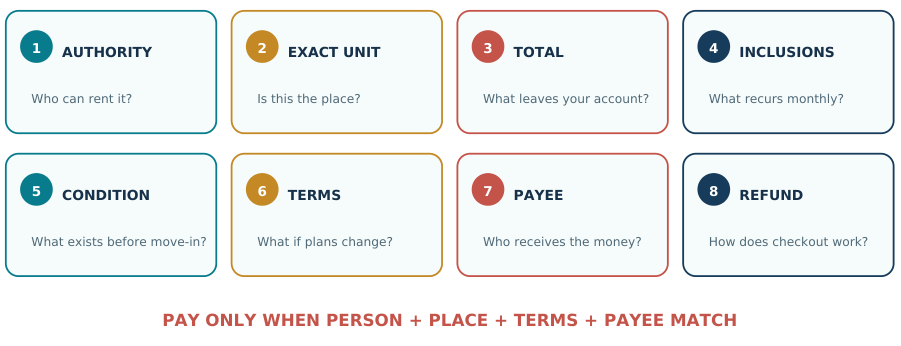
Use these eight questions before transferring a deposit or signing an agreement you do not understand. They apply whether you are renting directly from an owner or dealing with an agent. For a remote booking, replace the in-person inspection with independently verifiable evidence rather than relying only on the listing.
The one-page rule: If a significant answer is only verbal, ask for it in writing. A chat message can be useful evidence, but make sure the person making the promise is authorized to do so and that the final contract matches it.
1. Who is offering me the property—and are they authorized to do so?
Ask: “Are you the owner, property manager, or an agent? Who will be named as the landlord in the agreement? What shows that you are authorized to rent out this specific unit and receive my payment?”
A listing profile, a business card or an attractive website is not, by itself, proof that a person can rent you the property. Ask to see reasonable evidence of authority: for example, relevant ownership or management documentation, an agency authorization, or confirmation that can be checked independently with the building office. The right evidence depends on the arrangement. You do not need to circulate someone else's identity document or publish it to obtain reassurance.
Record: The contracting party's name, contact method, role, and who will sign the agreement. If the proposed payee is different from the contracting party, ask why and get a documented explanation before paying.
Pause if: You are pressed to send funds immediately while the person refuses to identify the landlord or explain a third-party account.
2. Am I paying for the exact place I saw?
Ask: “What are the building name, complete address, floor and unit number? Is this the very unit I viewed, or a similar unit?”
Compare the address on the listing, the messages, the proposed agreement and any invoice. Check the location and practical access: entry door, lift, street noise, route to transport, and whether the room is available for the dates promised. If you cannot inspect in person, ask for a live, date-aware video walkthrough showing the entrance and identifying features. An edited video alone is weaker evidence. Where feasible, verify the contact or unit details through a channel you found independently, not a number supplied only in the listing.
Record: The unit identifier, agreed dates, listing screenshots, and any discrepancies resolved in writing.
Pause if: The contract names a different building or unit, or you are told your actual room will be assigned after you pay.
3. Exactly how much money must leave my account, and what is each amount called?
Ask: “Please itemize the security deposit, any advance rent, reservation or holding fee, key/card charges, cleaning fees and other move-in charges in Thai baht (THB). Which items are refundable, and under what conditions?”
A security deposit is not the same thing as advance rent. A reservation payment may have different cancellation terms. An amount called a “fee” can be non-refundable under the proposed terms, so labels matter—but the contract and applicable law matter more than a label in a chat.
Make a simple payment schedule:
| Item | Amount (THB) | Due date | Refundable? / conditions |
|---|---|---|---|
| Security deposit | ______ | ______ | __________________ |
| Advance or first rent | ______ | ______ | __________________ |
| Reservation / holding payment | ______ | ______ | __________________ |
| Other itemized charges | ______ | ______ | __________________ |
| Total before move-in | ______ |
If you are paying from another currency, check the exchange rate, transfer fees and the amount the recipient must actually receive. Do not accept a single undifferentiated “deposit” total.
Thailand-specific legal caution: Thailand has consumer-protection rules for certain residential rental businesses, including a 2025 notification designating the residential-building rental business as contract-controlled. Coverage and contract requirements depend on the facts of the rental, so do not assume that one universal deposit limit or refund deadline applies to every private owner, hotel, serviced apartment or rental arrangement. Check the current Office of the Consumer Protection Board (OCPB) guidance or obtain qualified local advice before relying on a legal cap or right.
4. What is—and is not—included in the quoted rent?
Ask: “Does the rent include water, electricity, internet, parking, building or common-area fees, cleaning and maintenance? If not, who bills me, how is usage measured, and when do charges fall due?”
A low headline rent is not always a low monthly cost. Ask whether utilities are billed directly by providers or through the landlord/management, how meter readings are taken, whether air-conditioning is separately billed, and what happens if the internet fails. Check whether the rental includes furniture, bedding, a washing machine or a working water heater; listing photographs may show items not included.
Record: A written inclusion/exclusion list and the person to contact for repairs. Photograph initial meter readings with permission at handover.
Pause if: The rent is confirmed but the person cannot explain recurring charges or insists that unspecified fees can be decided later.
5. How will we record the property's condition before I take the keys?
Ask: “Can we do a joint move-in inspection with a written inventory, meter readings and dated photos? How do I report anything that is already damaged?”
Check walls, floors, windows, locks, plumbing, air-conditioning, appliances and furniture. Photograph existing stains, scratches, leaks and broken items before unpacking. Take close-ups and wider views that show where the issue is. For equipment, note whether it works rather than simply whether it exists.
A useful handover record has four parts: item or location → observed condition → photo reference → whom you notified and when. Send the list through the agreed written channel and ask the landlord or manager to acknowledge it. Protect anyone else's personal information and do not upload private documents to a public photo album.
Record: An inventory, numbered photos, meter readings, keys/access cards received and a dated acknowledgment. Keep copies in a private folder.
Pause if: You are asked to accept responsibility for damage without being allowed to inspect or document the existing condition.
6. Can I read the complete agreement before I pay—and what happens if plans change?
Ask: “May I read the full lease and house rules first? What are the start and end dates, notice requirements, renewal terms, early-departure arrangements and cancellation terms if the property is unavailable?”
Read the agreement, not just its heading. Compare the named parties, unit, rent, payment schedule, deposit, inventory, utility method, entry/repair arrangements and handover date. Make sure each material promise in the message thread is either reflected in the agreement or confirmed in a signed addendum. If the controlling version is in Thai and you do not understand it, obtain a reliable translation or qualified review before signing; an informal English summary may not settle a dispute over the signed text.
For a booking or holding payment made before the final lease, ask what exact written terms govern that payment and what happens if either side cancels. Do not assume that “refundable” is unconditional or that a familiar rule from your home country applies in Thailand.
Record: A copy of the agreement you reviewed, including all attachments and the signed final version. Check that you receive your own copy.
Pause if: The payee wants the money first and will only disclose the contract afterward.
7. How will I prove that I paid the right person for the right purpose?
Ask: “What name should appear as the payee? Can you provide an invoice or written payment instruction showing the unit, purpose, amount, currency and date—and a receipt when payment arrives?”
Prefer a traceable payment method that you can access later. Before sending, independently confirm any last-minute change to bank details through a known, verified contact channel. Keep a transfer confirmation, but remember that a screenshot of a transfer is not proof that the person receiving it had authority to rent the property.
Use a useful payment reference, where your bank permits one: Rental deposit – [unit] – [date]. Ask for an acknowledgment identifying the amount received, the reason for payment and the contractual party. Never send a one-time bank login code or card-security code to someone claiming it is required to “confirm” a rental.
Record: The written payment instruction, verified account details, transfer receipt and landlord/agent acknowledgment.
Pause if: You are asked to split payments among unrelated accounts, use an unfamiliar irreversible channel without explanation, or hide the nature of the payment.
8. What exactly happens to my deposit when I leave?
Ask: “Who inspects the property at checkout, what can be deducted, when will any balance be returned, where will it be sent, and how will we resolve a disagreement?”
Discuss move-out before move-in. Ask how much notice to give, whether a joint inspection can be scheduled, how outstanding utility bills will be calculated, and what documentation would support a damage deduction. Agree how keys and access cards are returned. Ask what happens if you have left Thailand before the final bill or inspection is complete, and whether a deposit balance can be refunded to your foreign account (including transfer charges).
Make the contract say how disputes are raised and which person receives them. Do not promise yourself a particular refund time based on a general online article. A rental-business rule may apply to some contracts and not others; your exact agreement, the property's status and current Thai law matter.
Record: Agreed checkout procedure, deductions and refund method in writing. Plan to repeat the condition photos and meter readings on your departure day.
Pause if: The answer is “we decide everything later” and the agreement gives you no usable way to challenge a deduction.
Your before-you-pay checklist
Tick only when you have evidence, not merely a verbal assurance.
- [ ] I know who the landlord is and have checked the agent's or payee's authority where relevant.
- [ ] The building, address and exact unit match my viewing and agreement.
- [ ] I have an itemized THB total separating deposit, advance rent and fees.
- [ ] I know which amounts may be retained, returned or credited to rent.
- [ ] I understand utilities, internet, parking, cleaning and repair responsibilities.
- [ ] We have a plan for dated photos, inventory, meters and move-in defects.
- [ ] I have reviewed the complete written terms, including cancellation and notice.
- [ ] The payment recipient and account instructions are independently checked.
- [ ] I can obtain a traceable receipt tied to this unit and payment purpose.
- [ ] The checkout inspection, deductions and refund process are recorded.
- [ ] Any material discrepancy has been resolved before transfer.
Decision guide: If the only missing detail is small and easily documented, ask for a written correction. If you cannot verify authority, the unit, the payment recipient or the written terms, do not send a deposit on the strength of pressure alone. Walk away when the person refuses reasonable verification.
Two messages you can adapt
Before paying:
“Thank you—I am interested in renting [building/unit] from [start date] to [end date]. Before I transfer funds, could you please confirm the landlord or authorized agent's name; the exact unit; a breakdown of the deposit, advance rent and other charges in THB; which payments are refundable; and a copy of the full lease and house rules? Please also send the recipient name and an invoice or written payment instruction. I will confirm the details before paying.”
At move-in:
“Thank you for the keys. I am attaching the move-in inventory, photos and meter readings taken on [date]. Please confirm receipt and let me know if you disagree with any of the recorded conditions. I will keep these with our agreement for checkout.”
If a dispute begins: Keep messages calm and specific. State the unit, date, relevant clause, amount, photos and the remedy you request. Do not send public accusations or share identity documents online. If the amount is material or the facts are disputed, obtain independent Thai legal or consumer advice rather than relying on a template.
One Thailand-specific point worth checking
Thailand's Office of the Consumer Protection Board (OCPB) has published material on a 2025 notification regulating contracts for certain residential rental businesses, including standard-form examples, and has publicly described inspections of covered rental businesses. This is a reason to check the current and applicable rule—not a reason to assume all hosts, individual landlords and hotel-like stays have identical duties. To investigate a consumer issue or ask which route may apply, use OCPB's official website or complaint service; its published contact information includes hotline 1166. If you encounter short-stay or hotel-like listings during your search, note that a hotel/short-stay lodging verification tool is not a guarantee about a private rental contract or deposit.
Sources and further checking (reviewed 20 October 2026)
- Office of the Consumer Protection Board (OCPB), Thailand: Official notice and standard residential lease material (Thai, published 8 June 2026). Consult the Thai original and current guidance for scope and requirements.
- OCPB, official inspection news: Enforcement checks against rental-business contracts, 20 February 2026. Establishes that the agency is actively addressing the 2025 contract notification; it does not decide your individual case.
- OCPB complaint routes: Official services / consumer complaints and hotline 1166. Check accessibility and instructions before submitting personal documents.
- Thai Tourist Police trust portal: Verified accommodation and scam-report information. The portal expressly says police listing checks do not resolve contracts or payment disputes. Use it, if relevant, for the type of accommodation it covers—not to verify a private tenancy's legal terms.
Editorial scope: general consumer-education information, not Thai legal, immigration, tax or financial advice. This article does not assert a nationwide deposit amount, mandatory lease language, refund deadline or guaranteed tenant remedy. Rules, contract coverage, documentation and payment practices can differ by property, provider and date. Check the current official source and obtain a qualified local review for a significant commitment.