Free · Thailand
Hotel, Serviced Apartment or Monthly Rental? Compare the Stay You Will Actually Use
A room costs less per night if you buy a month. That sounds useful until you discover that you need it for twenty-three nights, the electricity is separate, and the unused final week cannot be refunded. Another room has a higher headline rate but includes the days you need and lets you leave without a second payment. Which one is cheaper?
The name above the entrance will not answer that question. A hotel may sell a monthly package. A serviced apartment may offer daily and longer stays with different cleaning arrangements. A residential rental may leave much more of the practical setup to you. Compare the written offer for your dates, rather than treating those three labels as complete descriptions.
This guide is for someone choosing an ordinary temporary base in Thailand. It provides a way to compare costs, services, cash tied up in deposits, and the consequences of changing plans. It does not recommend particular accommodation, provide a current price survey, or decide whether a property is legally entitled to provide a particular stay. The calculations below use invented offers, not advertised market rates.
1. Describe the stay before comparing the rooms
Write down your arrival date, departure date, and what could change them. A thirty-night stay with a confirmed departure is a different purchase from a trip that might last anywhere between two and six weeks. The relevant uncertainty is not a vague possibility that something might happen. It is a specific event: your next assignment may start early, a family member may join you, or the place you want to live may become available later.
Then list the routines the accommodation must support. Someone out all day may only need a quiet bed and a reliable place to wash clothes. Someone working remotely needs to test the connection at the desk, not accept a photograph of a router. A family may need a usable food-preparation area and somewhere to store groceries. A person with limited mobility needs the actual entrance, lift and bathroom arrangements confirmed; a listing category does not establish accessibility.
Choose three non-negotiable needs. For example:
- A quiet room during the hours I will actually sleep.
- An internet connection suitable for my scheduled work, with a realistic backup.
- A departure arrangement that does not require paying for time I cannot use.
Do not let a pool or a particularly attractive lobby displace these needs unless you consciously decide that the trade-off is acceptable. A feature that appears in every photograph may have little effect on your ordinary Tuesday.
2. Translate the label into a list of services
These are questions to ask, not universal promises about each category.
| Offer label | What to establish for this offer | A misleading shortcut |
|---|---|---|
| Hotel | Exact room and dates, cleaning frequency, linen, internet, breakfast if any, cancellation and extension terms | Assuming the monthly package has the same services as the nightly rate |
| Serviced apartment | Which services are included, how often they happen, kitchen equipment, utility allowance or separate billing, repair contact | Treating “serviced” as meaning everything is included every day |
| Monthly residential rental | Minimum commitment, furniture and equipment, utility accounts, internet, cleaning, repairs, notice and handover process | Comparing only the rent with an all-inclusive hotel total |
There is a concrete reason to ask about the particular package. The accommodation operator PATT Serviced Apartments publishes daily and monthly options on the same rate page, with different inclusion lists. Its monthly description includes scheduled housekeeping and a utility allowance with separate excess-use charges. This is one operator's published offer, not a statement of the law or of typical Thai prices. The page also says its rates can change. Its value here is as a demonstration that a property name does not tell you what a specific package includes.[1]
For each finalist, ask for one written list covering cleaning, linen, utilities, internet, laundry, cooking facilities and repair support. “Kitchen available” might mean a shared room, a microwave, or equipment you are not permitted to use for the meals you have in mind. Ask what is physically present and what the house rules permit. Do not install your own appliance or alter wiring to compensate for something missing.
For cleaning, establish both frequency and responsibility. Does someone clean the room, supply materials, or only change linen? Are extra visits charged? Where do you put rubbish? Does the stated schedule apply to the exact monthly package? These are small questions that become recurring tasks after check-in.
3. Put every offer on the same calendar
Record arrival and departure as dates, then confirm the number of chargeable nights. Do not silently convert a quoted “month” into thirty nights. The offer might use a calendar month, a fixed number of nights, or a particular start-and-end period. Ask what happens if you arrive partway through that period or need one extra night.
Use the same dates in every enquiry. Include the number of occupants and any requirements that affect the price. A comparison is not valid if one quote is for one person and another is for two, or if one includes a mandatory departure charge that the other has not yet disclosed.
Your comparison page needs three dates:
- Quote date: when the offer was provided.
- Stay dates: the period the quote covers.
- Decision deadline: when the price, room or cancellation option expires.
Keep a copy of the quote and the terms that accompanied it. A later booking page may change. A screenshot can help you recall the offer, but it does not replace clarification of an ambiguous term or establish that you have a binding booking.
4. Keep cost separate from cash required
A refundable security deposit is money you need to have available. It is not automatically a cost you will lose, nor money you can safely assume will return on your departure day. Show it separately from non-refundable fees and from the amount payable for the stay.
Use two totals:
Expected stay cost = accommodation charges + mandatory non-refundable charges + estimated usage-based charges + optional services you have actually chosen.
Upfront cash required = payments due before or at arrival + refundable deposits or holds due at that time.
The first helps compare the purchase. The second helps determine whether you can afford the timing. A card authorization hold and a collected deposit may affect your available funds differently; ask the property and your card issuer about the exact arrangement. Do not add the same deposit twice merely because it appears in both the quote and the payment schedule.
For any refundable amount, record the conditions for deductions, the inspection process, how and when the refund is supposed to happen, and which payment route is used. An estimated future refund is not spending money available for your next booking.
5. A worked comparison: twenty-three usable nights
All figures in this section are fictional Thai-baht amounts chosen to demonstrate the method. They are not current offers, benchmarks, recommended prices or legal deposit limits.
You need twenty-three nights. You have three written offers:
| Fictional offer | Accommodation and included services | Other expected charges | Refundable amount due upfront |
|---|---|---|---|
| A: nightly hotel package | 900 THB per night for 23 nights; utilities and specified cleaning included | None identified in this exercise | 2,000 THB |
| B: fixed 30-night serviced package | 18,000 THB for the full period, with no refund for the unused seven nights | Estimated utilities 1,600 THB; mandatory cleaning charge 600 THB | 5,000 THB |
| C: monthly rental offer | 15,000 THB for its stated rental period | Estimated utilities 1,600 THB; internet 700 THB; chosen cleaning 1,000 THB | 15,000 THB |
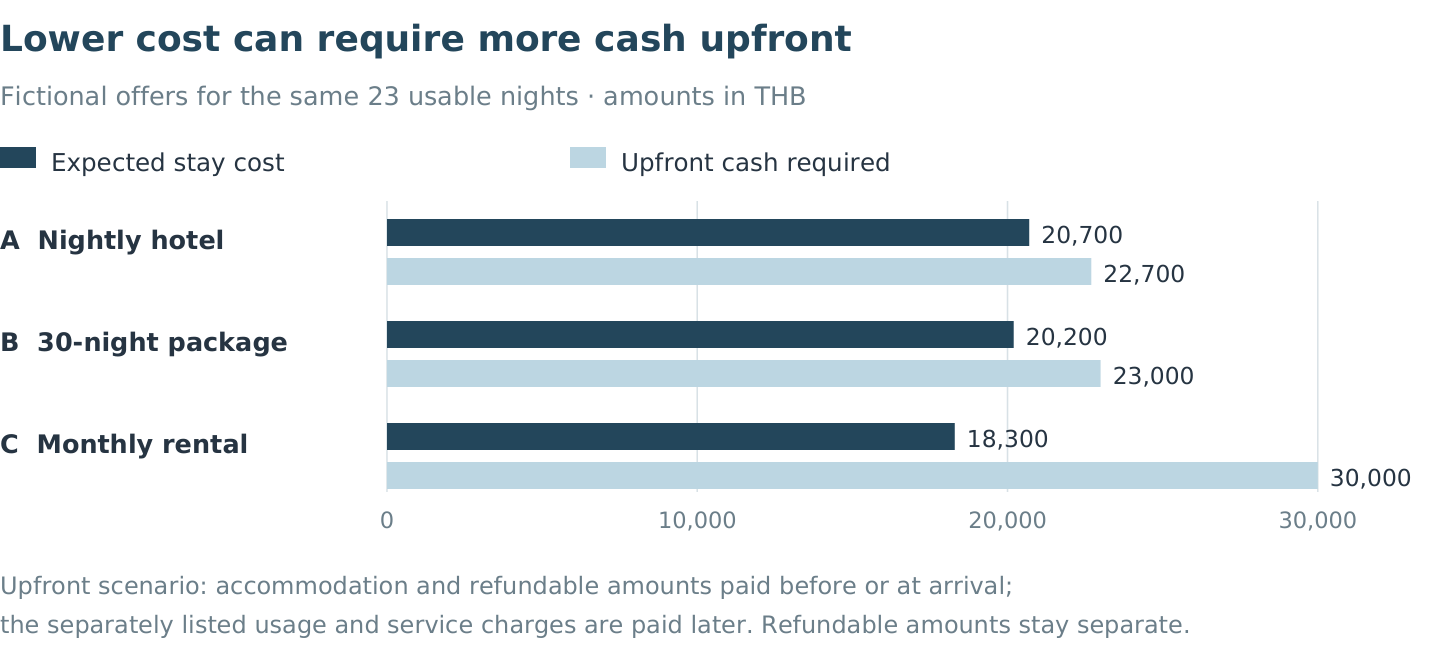
Expected cost A is 23 × 900 = 20,700 THB.
Expected cost B is 18,000 + 1,600 + 600 = 20,200 THB.
Expected cost C is 15,000 + 1,600 + 700 + 1,000 = 18,300 THB.
Divide by the twenty-three nights you can use, not by the thirty nights on an advertising line:
- A: 20,700 ÷ 23 = 900 THB per usable night.
- B: 20,200 ÷ 23 = approximately 878.26 THB per usable night.
- C: 18,300 ÷ 23 = approximately 795.65 THB per usable night.
C has the lowest expected cost in this invented comparison. That does not settle the choice. If accommodation and deposits are due upfront but the separately listed usage and service charges are paid later, the initial cash required is 22,700 THB for A, 23,000 THB for B, and 30,000 THB for C. C ties up substantially more cash. It also depends on the internet and chosen cleaning arrangement actually being available at the stated amounts.
The utility figures are estimates, not guaranteed totals. Ask what happens above the estimate and use a higher-use scenario if air-conditioning use or occupancy is uncertain. Never copy a supplier's advertised unit charge into a legal conclusion that the same charge is lawful for every rental.
6. Test the exit, not just the arrival
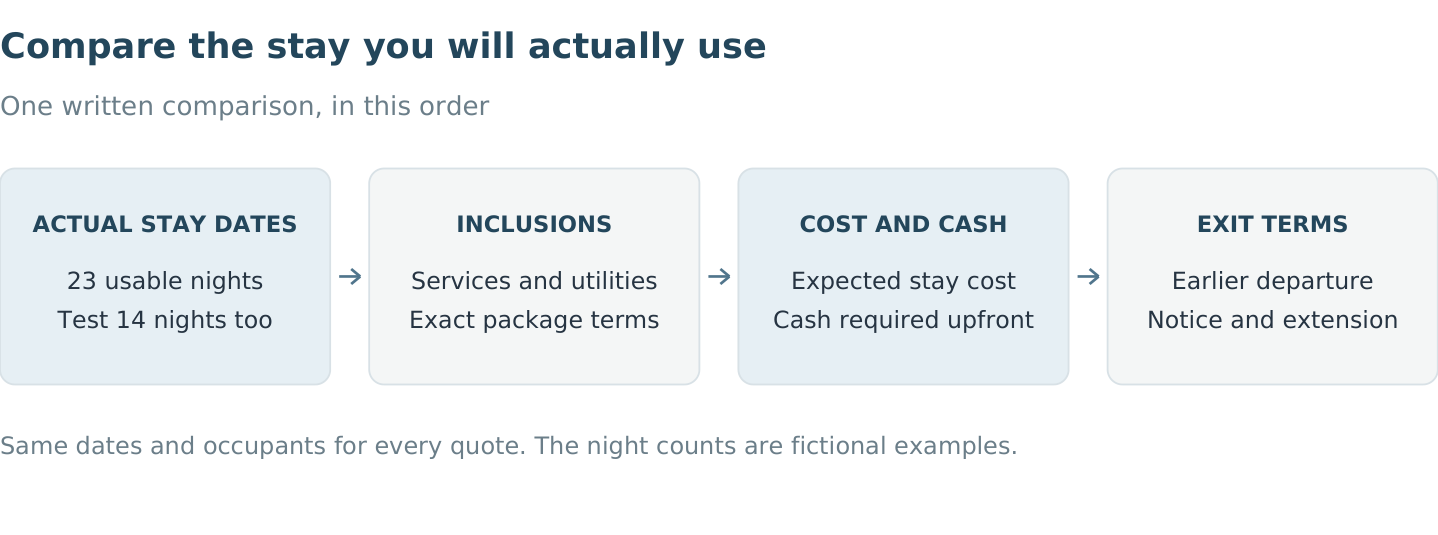
Repeat the comparison with an earlier departure. Suppose you might need only fourteen nights. Under the fictional A offer, assume the written terms allow you to pay only for those fourteen nights. A would then cost 14 × 900 = 12,600 THB. The fixed-period B and C accommodation commitments would not automatically shrink. Their exact early-departure terms determine what remains payable, and their usage estimates may change.
This is why “cheapest monthly rent” can be the wrong answer to “best purchase for uncertain dates.” You are buying both a room and a set of commitments.
Ask each provider:
- What amount would I owe if I left on the earlier date?
- Is an early-departure charge separate from accommodation already paid?
- What notice must I give, and how must I give it?
- Would extending the stay use the same rate, a new package or a daily rate?
- Is extension subject to the exact room still being available?
Do not infer a right to cancel from an informal phrase such as “flexible stay.” Have the applicable condition identified in the offer. Nor should you assume a familiar rule from your home country applies in Thailand.
Thailand's Office of the Consumer Protection Board publishes guidance and links to the 2025 residential-rental contract-controlled-business notification and a standard-contract example.[2] The existence of that framework is a reason to verify the actual legal category and coverage of your arrangement, not to apply a universal cap, cancellation rule or refund deadline to every hotel, serviced property and private rental. For a material uncertainty, obtain qualified local advice before committing.
7. Price the practical gaps without inventing precision
An inclusion list still needs testing. A room can include Wi-Fi yet fail at the desk where you intend to work. A kitchenette can exist but lack the equipment or permission you need. A laundry facility can be nearby but unavailable during your free hours.
Make each important gap concrete:
| Uncertainty | Evidence to request | How to treat an unresolved gap |
|---|---|---|
| Workable connection | A test in the actual room and clarification of outages/support | Keep a practical backup or reject the room if connectivity is essential |
| Cooking | Equipment list and written rules for that unit | Compare the likely meal arrangement without pretending every meal can be cooked there |
| Quiet | Actual room location, nearby works and relevant time of day | Avoid calling it verified quiet from a daytime photo |
| Repairs | Named contact, after-hours route and process for a broken essential | Do not count an unanswered promise as a working repair service |
| Access | Entrance, steps/lift, room floor and bathroom details | Obtain specific evidence for your needs rather than trusting a generic accessibility label |
You do not need to assign a baht value to every inconvenience. Mark an essential unknown as unresolved, not zero. A comparison table filled with invented numbers looks precise while making the decision worse.
8. Use one message for comparable quotes
Adapt this request to your actual situation. It is a request for information, not an agreement or payment authorization:
I am comparing accommodation for [arrival date] to [departure date], [number] occupants. Please quote the exact room/category and full amount for those dates, including mandatory charges and taxes. Please list cleaning, linen, internet, laundry and cooking facilities; explain utilities and any allowance; state the deposit or card hold and refund conditions; and provide the cancellation, early-departure and extension terms. My essential needs are [three needs]. Please identify any point you cannot yet confirm.
If the reply does not answer a material question, ask that question again narrowly. A long promotional reply is not equivalent to a completed comparison. Do not send passport copies, card details or personal documents merely to obtain an initial description unless you understand why they are necessary and are using a verified appropriate channel.
Once you have selected an offer, use the separate Thailand Plainly deposit and move-in guides for counterparty checks, room-condition evidence and meter records. This article's job is to choose a suitable arrangement before those handover steps, not to replace them.
Your comparison card
For each offer, record:
- Exact unit/category, occupants and usable stay dates.
- Full-period commitment and meaning of “month.”
- Expected cost, with uncertain usage shown separately.
- Upfront cash, separating refundable amounts and non-refundable charges.
- Three essential routines and what evidence supports them.
- Earlier-departure and extension scenario.
- Quote date, terms copy, named contact and unanswered questions.
Choose the offer that supports your actual dates and routines at an acceptable cost and commitment. The useful result is not a winner among three accommodation labels. It is a written comparison you can explain without guessing what is included.
Sources and limits
Sources checked 31 October 2026. No provider was contacted and no reservation was made.
- PATT Serviced Apartments, published rates and terms. First-party illustration of different daily/monthly inclusions and a utility allowance. Not an endorsement, market-rate survey, verified availability or legal validation of the provider's terms. No numerical advertised rates from this page are used in the fictional comparison.
- Office of the Consumer Protection Board, residential rental contract guidance, 8 June 2026. Official page links the B.E. 2568 (2025) notification and a standard-contract example. The visible article title is Thai despite the URL suffix. This guide does not independently determine an individual lease's statutory coverage.
- OCPB complaint portal. Official contact route, with telephone 1166 displayed. A contact route does not promise jurisdiction, a refund or a particular outcome in a reader's case.
This is general consumer education, not legal advice, individualized financial advice, or a property inspection. Offers, rules and actual operating conditions can change. Use current written terms and appropriate local expertise for decisions with significant consequences.