Free · Thailand
Reading an Address for Deliveries and Visitors
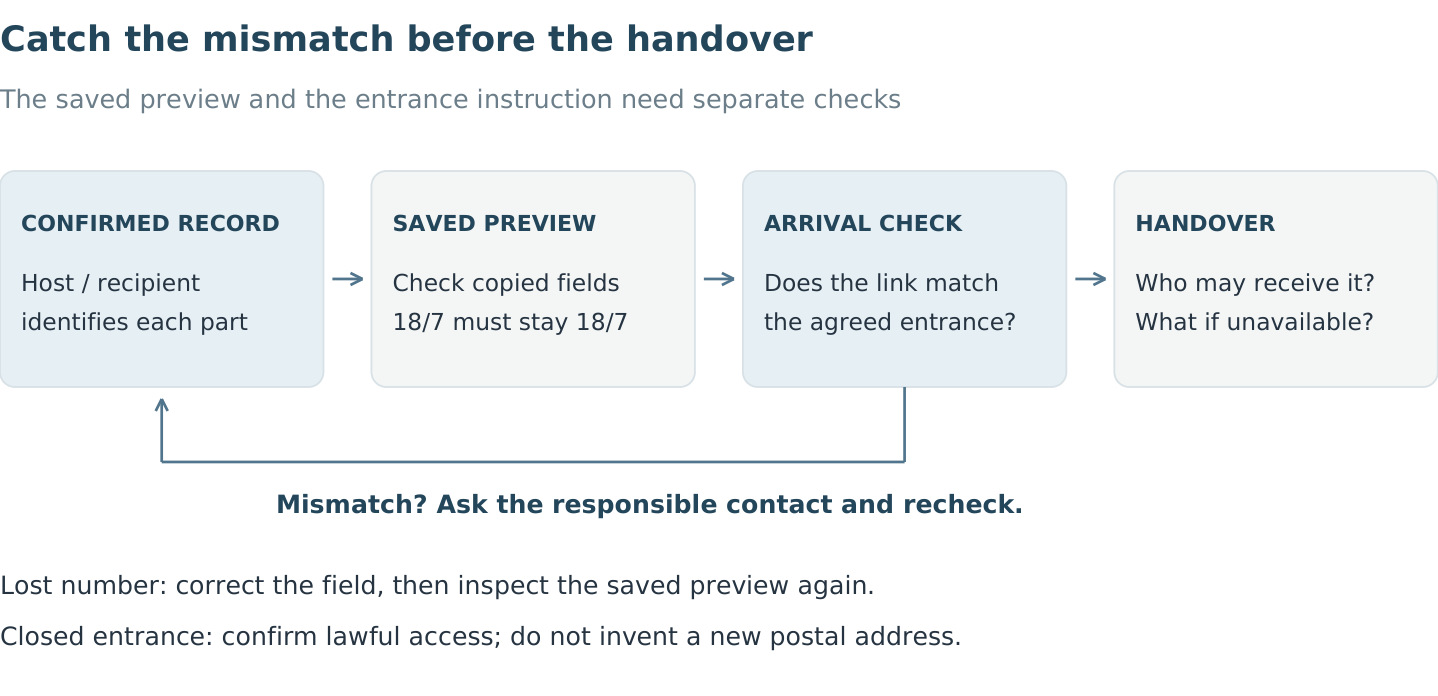
The driver has reached the right condominium complex. Your parcel has not reached you. There are two towers, the entrance shown on the map is closed, and the room number is missing from the delivery label. Everyone can truthfully say that they have the address. They are working with different pieces of it.
A useful address record answers three questions: Which premises? Which recipient or unit? How will the final handover happen? A postcode helps with the postal destination; a building name helps identify a property; an entrance instruction helps someone approach it. None should quietly replace the others.
This guide is for a visitor or temporary resident arranging ordinary deliveries and visits in Thailand. It provides a method for separating address components, checking copied information and giving a concise arrival instruction. It is not an official postal label specification, a courier's service promise, a Thai pronunciation lesson or an emergency-location procedure. The practice situations are invented and the templates contain placeholders, not deliverable addresses.
1. Decide what the other person needs
Start with the task, not with a map screenshot. A sender posting a parcel, a same-day courier and a friend arriving on foot may need different information. Ask the service what fields are required rather than assuming that a successful order in one app proves another carrier can use the same record.
| Task | Information to establish | What does not replace it |
|---|---|---|
| Postal parcel or letter | Recipient and complete postal address in the carrier's required format | A landmark or map link by itself |
| Local courier delivery | Written destination, exact building/unit, contact method and agreed handover point | A pin without the tower or receiving arrangement |
| Visitor meeting | Agreed public-facing entrance or meeting point, time and a way to contact you | A full postal address without access instructions |
Make a private master note containing the confirmed address and a separate arrival note. Then share only what that recipient needs. A friend meeting you at the reception desk does not necessarily need your room number. A postal sender may need it on the label. Do not turn the complete master note into a public social-media post.
2. Recognize the administrative levels
The Universal Postal Union's Thailand country sheet describes a five-digit postcode and distinguishes these administrative labels. Bangkok is treated at province level for this addressing description.[1]
| Level | Outside Bangkok | Bangkok |
|---|---|---|
| Province-level destination | Province, often labelled changwat | Bangkok |
| District | Amphoe | Khet |
| Subdistrict | Tambon | Khwaeng |
The sheet also describes moo in rural addresses, commonly translated as village but not necessarily identical to one settlement. The category words may be omitted from address lines or written in English or Thai. These roman-letter forms help you recognize fields; they are not pronunciation instructions.[1]
The practical consequence is simple: do not put the district into the subdistrict field merely because both names are unfamiliar. Ask your host or recipient to identify each value. A dropdown that fills itself is a proposed match, not your confirmation that the premises are correct.
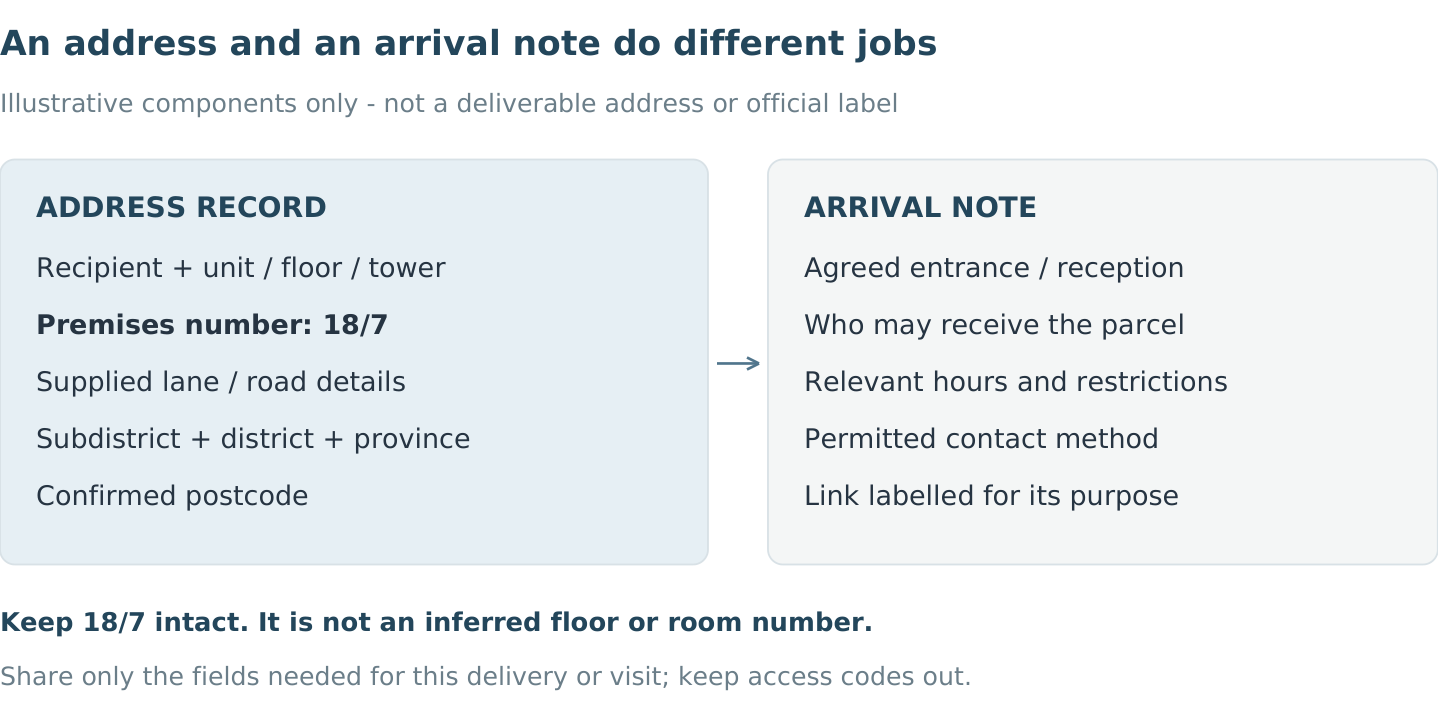
Keep premise numbers, room numbers and floor numbers distinct. If the host supplies a premise number such as 18/7, preserve the slash. That fictional example does not mean floor 18, room 7 unless the responsible person explicitly identifies it that way. Do not perform arithmetic on address numbers, remove punctuation to make them look tidy, or infer one missing component from another.
3. Obtain one confirmed written version
Ask the host, recipient or building's authorized contact for the exact address they use for incoming deliveries. Request a Thai-script version and, where needed, their matching roman-letter version. Keep both together. Copy the confirmed spelling rather than creating your own translation of a proper name.
A useful clarification is: “Which part is the premises number, which is the room or unit, and which are the subdistrict, district and province?” If the reply is another picture of a business card, ask for selectable text as well. It makes copying easier, but still compare the copied result with the original. An attractive screenshot is not proof that the contact or premises are genuine.
Record who confirmed the address and when. If you are moving between two properties with similar names, give the notes distinct labels and archive the old one after the move. Check the destination before reordering from an app's saved-address list. A correct address can still be the wrong address for today's delivery.
If two versions disagree, do not combine the first half of one with the second half of the other. Send the discrepancy back to the responsible contact: “This version has [X], while the other has [Y]. Which complete version should I use?” Save the clarified whole, not just an isolated correction you might forget to apply.
4. Separate the postal record from the arrival note
The following is an original component checklist, not a carrier-approved label layout. Replace every bracketed item with confirmed information; omit nothing a carrier requires and do not invent a value to fill a blank.
- Recipient: [name used for this delivery].
- Internal destination: [unit or room], [floor], [building or tower, if applicable].
- Premises and route details: [confirmed premises number and supplied lane/road details].
- Administrative destination: [subdistrict], [district], [province or Bangkok].
- Postal destination: [confirmed postcode] and [country when required for the shipment].
Keep the arrival note separate: “[Agreed entrance or reception point]. [Short identifying detail]. [Permitted contact method].” Add an expected time only when it has been agreed. For example, a fictional visitor instruction might be: “Meet at Tower B reception at 14:00. Use the entrance the host marked in the message. Call through our existing chat if the desk is closed.” This is not an address for a real building.
Before sharing a photograph of an entrance, check what else is visible. Crop out other residents, name boards, parcel labels, access codes and private documents. Do not photograph a restricted area or use someone else's access card to produce a more convenient arrival guide.
5. Check the postcode without guessing
The UPU's addressing service explains that postcodes support identifying and sorting postal destinations and provides a route to designated operators' postcode resources.[2] Use an official operator source, the carrier's support or the responsible recipient to resolve uncertainty. Do not select a code simply because it appears beside a nearby hotel in search results.
Checking that a code contains five digits is not the same as confirming that it belongs to your address. Nor does a postcode identify your room, guarantee a courier serves that building, or settle which entrance a visitor should use. Keep those checks separate.
If an order form changes the district or province after you choose a postcode, stop and compare the entire destination. Ask for help if the combination cannot be reconciled. Do not force a mismatched option merely to make the checkout button work. No particular postcode or working delivery route is validated by this article.
6. Use a map link as an additional check
Ask the host or recipient which entrance or meeting point they intend to share, and open the link yourself before forwarding it. Compare the named property, the side of the site and the written instruction. A marker in the middle of a large complex is not an entrance inspection. A suggested route does not authorize crossing a locked gate, entering private property or using an unsafe approach.
Google's current help distinguishes sharing a map or location link from sharing directions.[3] When you need a fixed meeting point, say what the shared item represents: “reception entrance,” “agreed pickup point” or “property location only.” If you cannot verify an entrance, say so rather than describing the pin as confirmed.
Do not confuse a fixed destination link with live location sharing. Google's documentation says real-time sharing can disclose the device's recent location and other information, including battery status, to the chosen recipient; it offers controls for recipients and duration.[4] Use it only deliberately. Check who will receive it and stop it when no longer needed. A public map pin is not a reason to expose your ongoing movements.
When a link and a written address conflict, ask the responsible contact to resolve the difference. Do not “correct” a private residence on a public map based only on a visitor's guess.
7. Agree the final handover
Ask whether deliveries are accepted at reception, at a designated parcel point or only by the named recipient. Confirm any relevant hours and restrictions directly. The presence of a desk, guard or locker does not establish permission to leave an item there. A courier's available service may also differ from the building's preferred arrangement.
For a parcel that matters to you, agree who may accept it and what you will do if that person is unavailable. Keep the order or tracking reference in the service's verified channel. Do not share account passwords, payment-card details or building access codes in delivery notes. A request to change payment details is not an address clarification; verify it separately through the service you already trust.
For a visitor, choose a meeting point they can lawfully reach. If they need step-free access or another accommodation, confirm that specific route with the property. A map label or a broad accessibility claim is not evidence that a particular entrance, lift or route will work for them.
8. Resolve three common mismatches
The building name matches but the tower does not. In this fictional situation, the host's note says Tower B while the app has saved only the complex name. Keep the agreed postal address intact, add the confirmed tower/unit in the appropriate fields, and check the final order preview. Ask where the courier is allowed to hand over the parcel. Do not solve the missing tower by substituting a different property's address.
The order preview has lost part of the number. You entered the fictional premises number 18/7 but the preview shows 18. Treat that as an unresolved change, not a harmless abbreviation. Recheck the input field and contact the service if necessary. Separately confirm the unit number; do not assume the missing part has moved there automatically.
The pin reaches a closed side entrance. The written address may still be correct. Ask for the lawful, currently usable meeting point and an updated instruction. Tell the arriving person what is unconfirmed while you check. Do not encourage climbing a barrier, following another resident inside or crossing a dangerous road to rescue a mistaken pin.
The goal is not to add more text to every order. It is to remove one specific ambiguity and check that the correction survives copying, saving and forwarding.
9. A message you can adapt
Send this privately to the responsible contact, replacing the brackets:
Please confirm the complete address for [postal delivery / courier / visitor]. Could you provide the Thai-script text and your matching roman-letter version, identify the premises number separately from the unit, and confirm the subdistrict, district, province or Bangkok, and postcode? Please also identify the permitted entrance or handover point and who may receive the item. If you send a map link, please say whether it marks that entrance or only the property. I will not treat any unanswered point as confirmed.
Then make a final four-part check:
- Identity: correct recipient, property, tower and unit for this occasion.
- Address: confirmed components copied without accidental omissions or substitutions.
- Arrival: link and entrance instruction agree, with unknowns plainly stated.
- Handover: receiving arrangement, contact method and privacy boundaries are appropriate.
You have finished when another person can understand both where the delivery belongs and what to do on arrival, without guessing from a landmark or being given unnecessary private information.
Sources and limits
Sources consulted 1 November 2026. No private address was collected, no delivery was ordered and no entrance was inspected for this guide.
- Universal Postal Union, Thailand addressing country sheet. Two-page sheet dated September 2017. Used for postcode structure, administrative labels and addressing distinctions, not as proof of current occupancy, carrier coverage or the continued accuracy of its sample addresses. No sample person's address is reproduced here.
- Universal Postal Union, Addressing Solutions. Postal Addressing Systems and postcode-resource sections explain the verification purpose of addressing information. This guide does not reproduce the UPU's licensed postcode database or certify an individual address.
- Google Maps Help, sharing directions, maps and locations. First-party guidance distinguishing the shared items. Menus and platform-specific steps can change; this article does not reproduce a map image or claim that a map verifies physical access.
- Google Maps Help, real-time location sharing. First-party explanation of information shared and recipient/duration controls. Availability and controls can vary by account and device.
Use current carrier requirements and the recipient's confirmed details for an actual delivery. This is a practical reading and communication method, not legal proof of residence, property ownership or a guaranteed delivery outcome.