Free · Thailand
Arrival Card, Visa and Passport: Different Jobs
You can have a valid passport and still need a visa. You can have a visa and still need a Thailand Digital Arrival Card. You can complete the arrival card correctly and still need to check the period of stay given at the border.
These are not duplicate documents. They answer different questions at different stages of a trip.
This guide gives first-time travelers a practical way to separate four things:
- Passport or travel document — who you are and what document you travel on.
- Visa, visa exemption or visa on arrival route — which pre-arrival entry route may apply to your passport, location and purpose.
- Thailand Digital Arrival Card (TDAC) — the arrival information submitted shortly before entry.
- Permission to stay recorded at entry — how long immigration permits you to remain on that entry.
The article deliberately does not publish a timeless nationality list. Entry arrangements can change, and eligibility can depend on more than citizenship alone. Use the official check relevant to your own passport, current location, purpose and travel date.
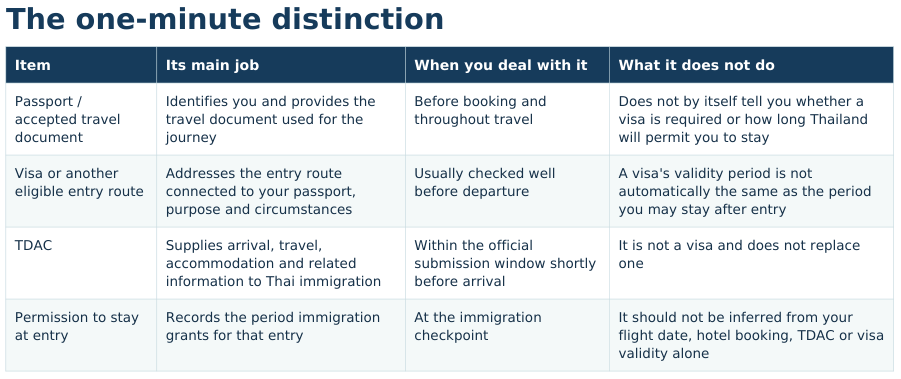
The one-minute distinction
| Item | Its main job | When you deal with it | What it does not do |
|---|---|---|---|
| Passport / accepted travel document | Identifies you and provides the travel document used for the journey | Before booking and throughout travel | Does not by itself tell you whether a visa is required or how long Thailand will permit you to stay |
| Visa or another eligible entry route | Addresses the entry route connected to your passport, purpose and circumstances | Usually checked well before departure | A visa’s validity period is not automatically the same as the period you may stay after entry |
| TDAC | Supplies arrival, travel, accommodation and related information to Thai immigration | Within the official submission window shortly before arrival | It is not a visa and does not replace one |
| Permission to stay at entry | Records the period immigration grants for that entry | At the immigration checkpoint | It should not be inferred from your flight date, hotel booking, TDAC or visa validity alone |
If you remember only one sentence, use this:
Your passport identifies the traveler; your visa or eligible alternative addresses the entry route; the TDAC reports the arrival; immigration records the permitted stay.
1. Start with the passport you will actually use
Travel advice often begins with “Do I need a visa?” A better first question is:
Which passport or travel document will I present for this trip?
That matters because official eligibility checks are tied to the travel document. A person with more than one nationality should not casually switch document details between a visa application, airline booking, TDAC submission and border presentation. Names, document numbers, nationality and dates should be checked for consistency.
Before moving to the next step, confirm:
- the document is the one you intend to use for the journey;
- the name used in the reservation matches the travel document closely enough for the carrier’s rules;
- the document will remain valid for the period required by the applicable route and carrier;
- it has the necessary usable pages or electronic capability where relevant;
- damage, a recent replacement or a changed document number has not made an earlier visa or application record unusable.
Do not copy a general “six-month passport rule” from an old blog and assume it resolves every case. Some official Thai visa pages state a minimum validity for that particular visa, but your applicable entry route and carrier checks must be verified for your own trip.
2. Then determine the entry route—not merely whether the word “visa” appears
Travelers may encounter several different labels: e-Visa, a visa issued by an embassy or consulate, visa exemption, or visa on arrival. These are not interchangeable names for the same process.
The official Thai e-Visa system asks for information including:
- country or territory of passport or travel document;
- current location and the mission through which the application is made;
- travel-document type;
- purpose of visit;
- visa type and number of entries.
That is a useful warning against one-variable reasoning. Nationality matters, but so can current location, purpose, document type and the requested entry arrangement.
A safe decision method
- Go to the official Thai e-Visa website or the relevant official Royal Thai Embassy/Consulate page.
- Enter or select your actual passport/travel-document country and current location.
- Check the route for your real purpose—tourism, business, study, family, work or another purpose—not the route a friend used.
- Read the permitted application location, required documents, number of entries, visa validity and stated period-of-stay information separately.
- Save the official result or guidance you relied on, with the check date.
Two common mistakes
Mistake 1: “My friend with a different passport did not need a visa, so I do not need one.”
Fix: Run the official check for the passport you will present.
Mistake 2: “My visa is valid for three months, so I may stay for three months.”
Fix: Separate visa validity from period of stay. Thailand’s Ministry of Foreign Affairs states that visa validity is the period during which the visa can be used to enter, while the period of stay is the time immigration permits after arrival. They are different clocks.
3. Complete the TDAC in its own window
The Thailand Digital Arrival Card is an online arrival form that replaced the paper arrival card. The official Immigration Bureau guide says non-Thai nationals entering Thailand must complete it online before entry, with stated exceptions described in the official FAQ and consular guidance.
The TDAC is required across air, land and sea arrivals. The official FAQ says it is compatible with visa, visa-on-arrival and visa-exempt entry routes. In other words, having one of those routes does not make the TDAC “already included.”
What the TDAC asks for
The official guide lists information such as:
- passport and personal details;
- travel information;
- accommodation information in Thailand;
- health-declaration information where prompted;
- an email address for receiving the submission result.
When to submit
The official TDAC FAQ states that it may be submitted no more than three days before arrival, including the arrival date. Do not submit months early. Do not leave it to an unofficial seller.
Use only the official free portal:
https://tdac.immigration.go.th/
The official guide explicitly says the TDAC is not a visa.
Who may be excepted
Current official guidance identifies limited exceptions, including travelers who transit or transfer without passing through immigration control. Official consular guidance also identifies Border Pass holders, and the Immigration Bureau FAQ says crew do not need a TDAC. Check the current official FAQ rather than stretching an exception to fit a different situation. If you leave the airport and pass through immigration, the transit exception does not apply.
Before pressing submit
Compare these fields against the passport and booking you will use:
| Field | Check |
|---|---|
| Full name | Matches the travel document; no nickname substituted |
| Passport number | Correct characters and correct current document |
| Nationality / citizenship | Matches the document used for entry |
| Arrival date | Matches the current itinerary, including after a flight change |
| Flight or vehicle details | Current arrival movement, not an earlier booking |
| Accommodation | The actual initial address requested by the form |
| Accessible during travel and typed correctly |
Save the downloaded or emailed TDAC confirmation so it remains available offline when you arrive at the immigration checkpoint. The official system allows updates before travel, but some identity fields may not be editable; follow the portal’s current instructions if a document number, name, nationality or date is wrong.
4. At entry, check the permission to stay—not just the visa label
A visa can be valid for use during a stated period, yet the period allowed after entry can be different. The Ministry of Foreign Affairs explains this distinction directly, and official Thai materials state that the period of stay is granted by an immigration officer upon arrival.
After immigration processing, check the entry record or stamp associated with the passport you used. Do not calculate your last lawful day only from:
- the expiry date printed on a visa;
- the return date on your ticket;
- the final date of a hotel booking;
- the validity of a travel insurance policy;
- the date shown on the TDAC.
Those may be useful planning dates, but they do not all perform the same legal job.
If the recorded date appears inconsistent with the entry route you expected, seek clarification promptly from Thai immigration through an official channel. Do not wait until the assumed final day.
A four-document pre-departure check
Use this at least once before travel and again after any itinerary or passport change.
| Check | Your evidence | Status |
|---|---|---|
| Passport/travel document selected and valid for the applicable route | Document number ending ___; official/carrier rule checked on ___ | ☐ |
| Visa or eligible alternative confirmed for my passport, location and purpose | Official page/result saved at ___ | ☐ |
| TDAC submission window placed in calendar | Earliest submit date ___; arrival date ___ | ☐ |
| First accommodation details available for TDAC and arrival | Address saved privately at ___ | ☐ |
| Name, passport number, nationality and arrival details agree across records | Compared on ___ | ☐ |
| Visa validity and expected period of stay recorded as separate concepts | Notes stored at ___ | ☐ |
| TDAC confirmation available offline | Saved at ___ | ☐ |
| Permission-to-stay record will be checked immediately after entry | Reminder set at ___ | ☐ |
Three quick scenarios
Scenario A — Visa-exempt traveler
An official check indicates that the traveler’s passport and tourism circumstances qualify for visa-exempt entry. The traveler concludes that no other form is needed.
Correction: Visa exemption answers only the visa-route question. The traveler should still check the TDAC requirement and prepare the passport, arrival and accommodation information required by the official form.
Scenario B — Visa with a future expiry date
A traveler sees that a visa remains valid for several months after arrival and assumes that this is the departure deadline.
Correction: Visa validity and period of stay are different. The traveler should check the permission to stay recorded at entry and any conditions applying to that visa category.
Scenario C — Passport replaced after approval or booking
A traveler receives a new passport after making bookings or obtaining an entry document. The old and new passport numbers differ.
Correction: The traveler should not silently copy the old number into new forms or assume every approval transfers automatically. Check the issuing authority’s instructions, the official Thai mission or e-Visa channel, the airline, and the TDAC record as applicable. Carrying an old document may or may not solve the issue; obtain route-specific official guidance.
Where to verify each question
| Your question | Best first official source |
|---|---|
| Do I need a visa or which visa fits my purpose? | Thai e-Visa official website and the responsible Royal Thai Embassy/Consulate |
| What is the difference between visa validity and period of stay? | Thailand Ministry of Foreign Affairs — General Information |
| Who submits the TDAC, when, and what information is required? | Immigration Bureau TDAC Guide |
| Do transit travelers, crew, children or visa-exempt travelers need a TDAC? | Immigration Bureau TDAC FAQ |
| Where do I submit the TDAC? | Official TDAC portal |
| What date was I actually permitted to stay until? | The entry record/stamp for the passport used, with prompt clarification from Thai immigration if unclear |
Final rule: check the right clock
There may be several dates on your screen at once:
- passport expiry;
- visa issue and validity dates;
- TDAC submission window;
- arrival date;
- permission-to-stay date;
- hotel checkout;
- return ticket.
Treating them as one date creates avoidable mistakes. Label each date by the document and decision it controls.
Practical takeaway: Before departure, verify the passport, establish the correct visa or alternative route, and calendar the TDAC window. At arrival, present consistent information and check the permission to stay recorded for that entry. Four jobs, four checks.
Sources and limits
Sources were checked on 23 October 2026:
- Thailand Immigration Bureau, TDAC Guide: purpose, required information, submission process and statement that TDAC is not a visa.
- Thailand Immigration Bureau, TDAC FAQ: submission window, air/land/sea coverage, transit and crew exceptions, and compatibility with visa, visa-on-arrival and visa-exempt routes.
- Royal Thai Consulate-General, Hong Kong, TDAC guidance: implementation from 1 May 2025, three-day window and stated exceptions.
- Thailand Ministry of Foreign Affairs, General Information: distinction between visa validity and period of stay.
- Official Thai e-Visa website and application guide: official application route and eligibility inputs involving passport/travel-document country, current location, purpose, visa type and entries.
This article explains document roles and a verification process. It does not determine any individual’s eligibility, promise admission, replace carrier requirements or provide legal representation. Rules and official interfaces can change; recheck them for the actual passport, purpose, route and travel date.